Scaling Wide: When Low-Ticket Ads Stop Scaling
TL;DR
Scaling wide means building more winning campaigns while keeping each at a budget its results support. You can still raise individual budgets. The difference is that your account's growth doesn't have to come from pushing the same few winners harder.
The scaling-wide lesson
Read the method below. The recorded whiteboard lesson will appear on its watch page after upload.
Your low-ticket ads are profitable. They've been working for days, weeks, maybe months. You increase the budget and they just die. You've got the campaign structure somebody recommended, you've followed their scaling method, and the numbers still go backwards. I've found this happens quite a lot with low-ticket.
Sometimes you can put the budget up massively and it keeps working. Great, keep doing that. What I'm talking about here is the account where you keep hitting a limit on the same few campaigns, even though the offer itself is already converting.
This is the written version of my scaling-wide whiteboard lesson. The video is recorded and will be embedded there after upload. I'm talking about an existing low-ticket acquisition funnel, especially one feeding a high-ticket offer, mid-ticket programme or membership. Not launching a cheap product from scratch.
What I mean by scaling wide
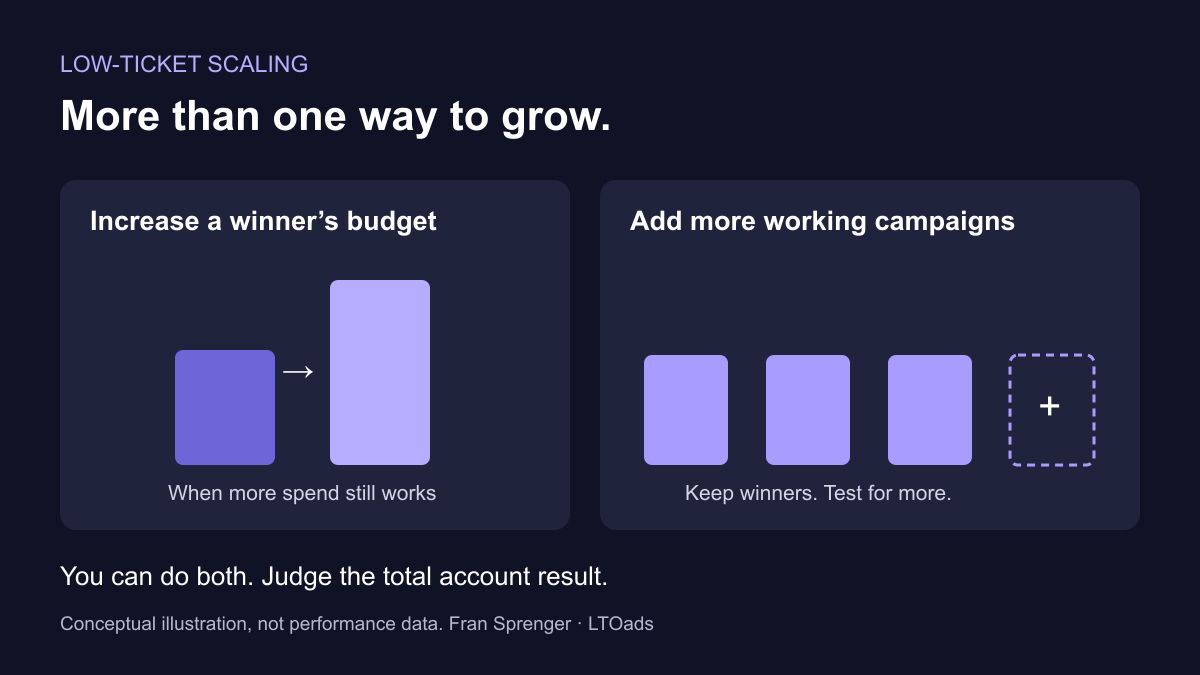
I aim to build more winning campaigns, rather than relying on a couple of winners and trying to spend as much as possible through them. I'll still try to increase the budget on each one. But if a campaign works at a lower spend, I don't need to force it past that point for the whole account to grow.
The important bit is keeping the things that are working running while you find more. Different angles, formats and reasons to buy can give you more to test. And, as I explain below, sometimes I'll test a duplicate of a campaign that's already working.
This isn't a rule that you need 30 or 50 campaigns. I mention those numbers in the recording because an account can end up with a lot of winners. It isn't a target to copy regardless of your budget. You still need enough spend to evaluate what you're testing.
I'm not saying the two-campaign method is wrong
In the video I talk about the testing-and-winners approach, which I associate with Hernan Vazquez. He's one of the people I rate in this space. The basic version I describe is a testing campaign and a winners campaign, with the winning ads moved across and the losing ones replaced.
That absolutely can work. In some accounts it can work better than what I'm proposing. I'm not trying to turn this into an argument where one setup is right and everything else is wrong.
My concern is depending on one winning campaign to keep carrying more and more spend. If that campaign starts struggling, a lot of the account's performance goes with it. I prefer having more things working at the same time, where the account's budget and results support that.
An ad that barely spent hasn't had the same test as a loser
Let's say you've launched 15 ads and only three or four are getting much spend. It's tempting to assume the rest must be bad because Meta didn't choose them. I don't treat that as a final verdict.
One thing I've done is duplicate that campaign, turn off the previous winners in the duplicate, and let the remaining ads get a test. The original winning ads can stay running in the original campaign. I'm not telling you to switch off your profitable ads across the account.
I've found more winners this way. That doesn't mean every ignored ad is secretly brilliant, or that you should keep paying to prove a losing ad works. It means an ad with very little delivery and an ad that's had a meaningful test are two different things.
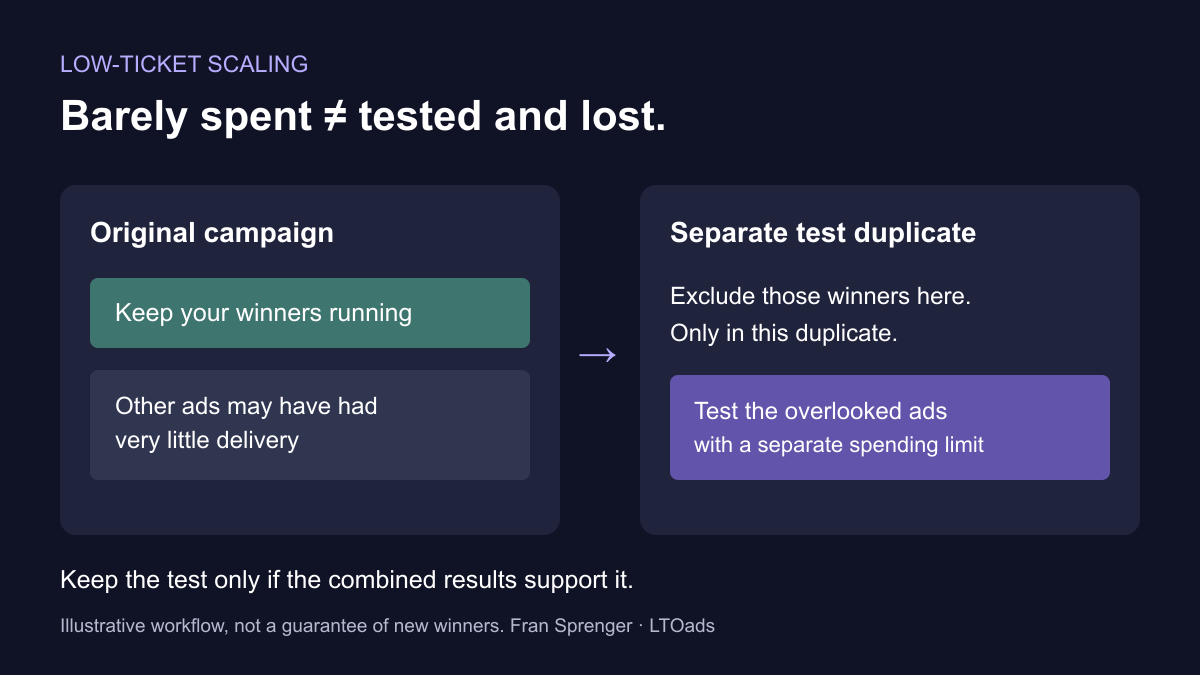
Give that new test its own spending limit and judge what actually happens. If you need a way to organise the hypotheses and budget, the low-ticket creative testing guide covers that part. The recording is about the scaling approach, not an exact ad-set setup.
Sometimes I'll test a duplicate of a winning campaign
There's another version of this. A campaign is working, you try to increase it, and the numbers fall apart above a certain level. Sometimes I'll bring it back down and test a duplicate, including an exact duplicate.
Here's the hypothetical example from the video. You get a campaign to $1,000 a day and it starts losing money. You bring it back to around $800, where it works, then test another campaign at $800. If both actually spend that amount and stay profitable, that's $1,600 a day overall.
That isn't a client result or a promise that duplicating a campaign doubles your profitable spend. It's an example of the decision. A duplicate might work differently, might lose money, or might just redistribute purchases between campaigns. You've got to check the combined result, not celebrate because there's another green row in Ads Manager.
And if the duplicate doesn't work, it doesn't earn a place in the account. Scaling wide still means keeping winners and stopping losers. More campaigns by itself isn't the achievement.
Why I care about keeping a winner running
A campaign doesn't have to take your whole budget to be useful. I'd rather keep getting worthwhile results from it at a spend it can handle than insist that it scales much further right now.
Let's say you have 20 things working and two stop working. You've still got 18. Those are illustrative numbers, but that's the point: the account is less dependent on one or two things continuing to perform.
It doesn't make the account immune to problems. Those campaigns can still share the same offer, audience and checkout, so a problem there can affect all of them. What it changes is how dependent you are on a small number of campaign winners.
I still go back and try increasing budgets again. Sometimes it works; sometimes it doesn't. I'm not saying put everything at $50 and leave it there forever. Follow your scaling method where it's working and keep adding to the range of winners.
What I'd check before trying it
Before treating a bad result as a scaling ceiling, check that you're comparing periods with a similar amount of time to convert. A delayed purchase, broken tracking or checkout problem isn't something campaign duplication fixes. The low-ticket attribution guide helps separate those questions.
Then decide what winning means for your funnel. If low-ticket is acquiring customers for your main offer, frontend ROAS isn't the whole picture. Look at acquisition cost and the contribution those buyers actually produce through the funnel, including refunds, fees and the time it takes to collect backend revenue. Don't count sales you merely hope will happen.
- Keep a record of the original campaign, its spend and results before changing anything.
- Decide whether you're testing new creative, overlooked ads or a duplicate of a winner. Those aren't the same test.
- Set an affordable test budget and a review point that allows for your conversion lag.
- Compare total spend, buyers and contribution across the account, not just the new campaign's reported ROAS.
- Keep the additional campaign only if the combined result supports it.
Those checks are implementation safeguards added to this written guide. The video itself doesn't prescribe a universal testing budget, campaign count or stopping threshold. The break-even calculator can help with the economics, but your own observed costs and sales need to supply the inputs.
Won't all those campaigns compete with each other?
That's the obvious objection, and it's a reasonable one. In the accounts I'm describing, I haven't seen the CPM blow-up people predict just because I used more campaigns. That's my experience, not proof that overlap and fragmented delivery can never hurt performance.
You could find something different. Smaller budgets, insufficient conversion data and campaigns reaching the same people can make adding more campaigns a poor choice. I wouldn't keep a complicated account structure if a simpler one produced a better total result.
Do you still scale individual campaign budgets?
Yes. That's worth repeating because otherwise this sounds like I'm against increasing budgets. I'm not. If you can keep increasing a campaign profitably, do it. Scaling wide gives you more campaigns to work with instead of needing every increase to come from the same place.
Is this a fix for every ad that stops working?
No. I'm describing an approach I've found useful for low-ticket ads, particularly where increasing spend repeatedly hurts performance. Creative fatigue, measurement issues and funnel problems can need different fixes. I also don't claim the same approach applies to direct-to-high-ticket campaigns or webinars; that's outside what I cover in this lesson.
If you want someone to run this side of the business
If your low-ticket funnel already converts and you want to outsource the ads, that's the work I do. I handle the media buying and strategy personally, with support for video editing and number tracking. The service covers essentially everything before the landing page.
It's aimed at businesses using low-ticket to acquire customers for a high-ticket offer, a mid-ticket programme or a membership, ideally with strong backend sales already. CRO and funnel changes are separate from recurring ads management. You can see the scope and book a call here.

Written by Francis Sprenger
Founder, Low Ticket Ads Agency
Francis specializes in low ticket Facebook advertising, helping digital product creators scale their offers profitably using proven systems and frameworks.
Related Articles
Diagnosing Ad Set Drift: Why Your Low-Ticket Ads Lose Steam
Ever seen a Meta ad campaign start strong, then inexplicably decline, as if the algorithm lost its way? This 'ad set drift' is a common, frustrating issue for low-ticket sellers. We'll show you how to diagnose and effectively combat it.
Ignored Metrics: Unveiling Hidden Low-Ticket Profit Levers
Often, course creators and coaches chasing low-ticket profits focus solely on ROAS. But what if the metrics you ignore are costing you thousands? Dive into the hidden data points that reveal true campaign health and unlock scaling.
Low Ticket Ad Budget: The Scrappy Scaler's Blueprint
For low-ticket offers, every ad dollar counts. Discover our blueprint for lean, strategic budget allocation that maximizes ROI and sets your campaigns up for sustainable scaling, even with tighter budgets.
Want me to run your low-ticket ads?
For existing converting low-ticket funnels acquiring customers for a high-ticket offer, mid-ticket programme or membership. Full-stack media buying, essentially everything before the landing page. CRO is separate.
See the ads-management service